Showing posts with label Renault. Show all posts

2010 Renault Laguna Sports cars wallpapers and previews

2010 Renault Laguna Sports cars wallpapers and previews
Following its unveiling at last month's 2010 Geneva Motor Show, the new Monaco GP limited edition version of Renault Laguna Sports Car Coupé is due to hit the French market this month when it goes on display at the Coupé-Cabriolet & SUV Motor Show in Paris.

2011 New Renault Sports Cars Megane GT/GT Line cars wallpapers and reviews

2011 New Renault Sports Cars Megane GT/GT Line cars wallpapers and reviews

2011 New Renault Sports Cars wallpapers and images

2011 New Renault Sports Cars wallpapers and images
Renault Sports Cars Technologies has helped create two new sporting versions of Renault’s New Mégane – GT and GT Line. 2011 New Renault Mégane GT and GT Line, unveiled at the Geneva Motorshow in March, are available across of the body types that make up the Mégane family (Hatchback, Coupé, Estate, Coupé-Cabriolet) and go on sale in June.

Renault revealed Renault Twingo Gordini R.S.

Renault revealed Renault Twingo Gordini R.S with cars images
The Renault Twingo Gordini R.S. will be powered with a 1.2L TCe or Turbo Controlled Efficiency with 74 kW and dCi 85 diesel with 63 kW. The Renault Twingo Gordini R.S. special edition will be available with traditional Malte Blue metallic paint of Gordini line with double white lines diagonally length of the car.
Renault Twingo Gordini R.S.Renault Twingo Gordini R.S.Renault Twingo Gordini R.S.

Renault DeZir first look wallpapers

Renault DeZir first look wallpapers
Renault DeZirRenault DeZirRenault DeZirRenault DeZirRenault DeZirRenault DeZirRenault DeZirRenault DeZir

Renault introduces short-term entry-level 'Bizu' range (UK)


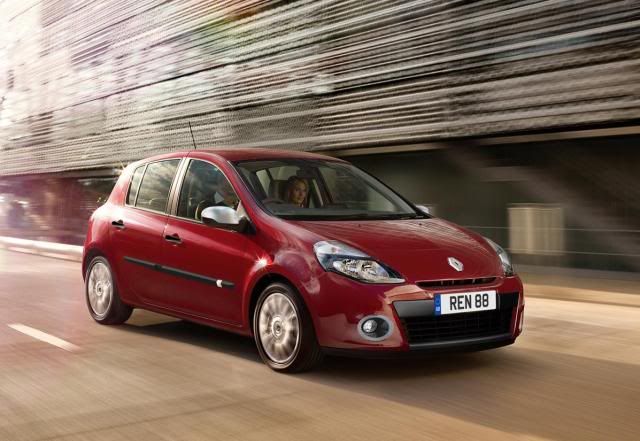
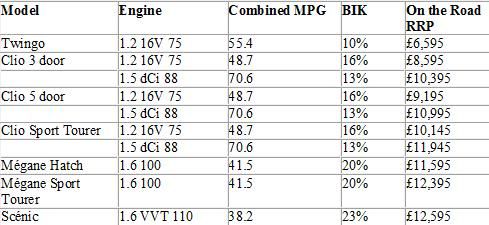
Renault has introduced a provisional budget line-up, called Bizu. Bizu was intended "to tempt customers looking for greater value for money", and flows from the entry-level Twingo city-car to the Scénic compact MPV (excluding the Wind roadster).

Available until June, the Bizu models can offer savings of upto £3,870 can when compared with entry-level models. The base Twingo 1.2 16v 75bhp Bizu starts at £6,595, rising to £12,595 for the Scénic 1.6 VVT 110bhp.


All Bizu models feature ABS, brake assist, electric front windows and Bluetooth connectivity w/AUX input as standard. The Clio Bizu is equipped with body-coloured rear spoiler and brushed chrome effect fog-light surrounds.

The Mégane and Scénic models have ESC, electrically adjustable, heated door mirrors, air-conditioning and keyless entry.

Renault Electric Sports Car DeZir Concept


Renault Electric Sports Car DeZir Concept
The Renault DeZir project is the first to have been led by Laurens van den Acker and marks the start of a sequence of concept cars that will provide an insight into Renault Design's new vision for the future. DeZir stands out as an illustration of the brand's commitment to more emotional styling.

The DeZir is a two-seater coupé that Renault says stands out as an illustration of the company’s commitment to more emotional styling. With its sports car looks and ability to accelerate from 0 to 100 km/h (62mph) in five seconds, or 0 to 50 km/h in just two seconds, it’s hard to disagree.

Although the DeZir is purely a concept car at this point, Renault is strongly hinting that it shows not only the direction they plan on heading with sports cars in the future, but that it is indicative of a new overarching design and styling philosophy across the entire Renault brand.
The 'Z' in the name Renault DeZir is a direct reference to Renault's Z.E. signature, and several features of its design are suggestive of two qualities readily associated with electric mobility, namely advanced technology and light weight.

DeZir is powered by an electric motor mounted in a mid-rear position to optimize weight distribution over the front and rear wheels. The vertically-mounted 24kW/h lithium-ion battery is located behind the benchseat and provides the car with a range of 160km.
Battery cooling is ensured not only by the air channelled from the front to the back of the car, but also – and above all – by the flow of air that enters through the lateral scoops concealed behind the aluminium panels on either side of the body.

Employing the same principles as the KERS (Kinetic Energy Recovery System) seen in Formula 1, when the car decelerates, kinetic energy is recovered and stored in the battery. This energy can then be employed by the driver to provide a temporary power boost using a button located on the steering wheel. The car can be charged in 8 hours at 240-v, can get to 80% charge in 20 minutes at 4o0-v (3-phase) and will accept battery swapping made possible by the Better Place alliance.

The basic motor is the same as the unit used for Renault's production electric cars, although an evolution has enabled its power and torque to be uprated to 110kW (150ch) and 226Nm respectively. Through the extensive use of lightweight materials such as the Kevlar body, the DeZir tips the scales at just 830kg or 1,830 pounds. According to the French carmaker, the DeZir can go from zero to 100km/h (62mph) in 5 seconds and reach a top speed of 180km/h or 112mph.

The DeZir will debut in October at this year's Paris Motor Show, but no date has been set for its full release. According to Fast Company, by the end of 2013 the Renault-Nissan alliance hopes to produce 500,000 electric vehicles globally, including the 2011 Fluence ZE and the 2011 Kangoo ZE electric van.

Renault Electric Sports Car DeZir Concept


Renault Electric Sports Car DeZir Concept
The Renault DeZir project is the first to have been led by Laurens van den Acker and marks the start of a sequence of concept cars that will provide an insight into Renault Design's new vision for the future. DeZir stands out as an illustration of the brand's commitment to more emotional styling.

The DeZir is a two-seater coupé that Renault says stands out as an illustration of the company’s commitment to more emotional styling. With its sports car looks and ability to accelerate from 0 to 100 km/h (62mph) in five seconds, or 0 to 50 km/h in just two seconds, it’s hard to disagree.

Although the DeZir is purely a concept car at this point, Renault is strongly hinting that it shows not only the direction they plan on heading with sports cars in the future, but that it is indicative of a new overarching design and styling philosophy across the entire Renault brand.
The 'Z' in the name Renault DeZir is a direct reference to Renault's Z.E. signature, and several features of its design are suggestive of two qualities readily associated with electric mobility, namely advanced technology and light weight.

DeZir is powered by an electric motor mounted in a mid-rear position to optimize weight distribution over the front and rear wheels. The vertically-mounted 24kW/h lithium-ion battery is located behind the benchseat and provides the car with a range of 160km.
Battery cooling is ensured not only by the air channelled from the front to the back of the car, but also – and above all – by the flow of air that enters through the lateral scoops concealed behind the aluminium panels on either side of the body.

Employing the same principles as the KERS (Kinetic Energy Recovery System) seen in Formula 1, when the car decelerates, kinetic energy is recovered and stored in the battery. This energy can then be employed by the driver to provide a temporary power boost using a button located on the steering wheel. The car can be charged in 8 hours at 240-v, can get to 80% charge in 20 minutes at 4o0-v (3-phase) and will accept battery swapping made possible by the Better Place alliance.

The basic motor is the same as the unit used for Renault's production electric cars, although an evolution has enabled its power and torque to be uprated to 110kW (150ch) and 226Nm respectively. Through the extensive use of lightweight materials such as the Kevlar body, the DeZir tips the scales at just 830kg or 1,830 pounds. According to the French carmaker, the DeZir can go from zero to 100km/h (62mph) in 5 seconds and reach a top speed of 180km/h or 112mph.

The DeZir will debut in October at this year's Paris Motor Show, but no date has been set for its full release. According to Fast Company, by the end of 2013 the Renault-Nissan alliance hopes to produce 500,000 electric vehicles globally, including the 2011 Fluence ZE and the 2011 Kangoo ZE electric van.

2011 New Renault Cars Latitude Family Saloon

Through much of the last decade, Renault's product lineup lived up to the long-standing French reputation for peculiar design. This was particularly true of its flagship model, the bizarre looking five-door hatchback Vel Satis. That unsuccessful model is now set to be replaced by a much more conventional looking four-door sedan dubbed the Latitude. The Latitude is built on a stretched version of the mid-sized Laguna platform and shares its powertrain options, including the new 3.0-liter diesel V6.
The Latitude is based on the Renault Group’s 2010 Samsung SM5 sedan — which itself is based on the Renault Laguna — that recently went on sale in South Korea. Renault has today provided the first glimpse of its latest international status-enhancing family saloon, Renault Latitude. The Renault Latitude will replace the discontinued and controversial Vel Satis hatchback. Tailored to meet the demand of its different markets, Renault Latitude's specification will deliver the car's different customers a truly high-end package that will position it as the spearhead of international Renault's saloon car range. It will be shown at the forthcoming Moscow Motor Show, Russia, and is due to go on sale this autumn in Asia, Africa, Russia, Turkey, Gulf, Australia and Mexico.
European version of Renault Latitude will be one of the principal new attractions of the 2010 Paris Motor Show where visitors will get a chance to examine its interior design, while full details of the model’s equipment lists and engines ranges will also be released. The international media will be invited to road test Renault Latitude before the end of 2010, and sales will begin shortly afterwards. The contours of the grille are flanked by distinctive bi-Xenon adaptive directional headlights, while chrome embellishments contribute to the unmistakable impression of dynamism and status exuded by the car's overall lines. Its rear-end forms point to ample boot space, and the new car can effectively claim one of the biggest boots in its class. The rear lighting signature employs LED technology and harmonizes perfectly with the chrome rear strip which carries the new model's name: Renault Latitude.
Based on the same architecture as New SM5, which was recently launched in the Korean market, Renault Latitude profits extensively from Renault's engineering expertise. Occupants benefit from a comfortable, silent ride, as well as a particularly precise chassis and a choice of powerplants that are sure to give it a decisive edge over its rivals. The complete equipment list, which will be revealed at a later date, places the emphasis on innovation and travelling comfort, including a dual-mode air ionizer with double fragrance diffuser, triple-zone climate control, a massaging driver's seat, Bose Premium audio, the Renault hands-free card, etc.
Related Posts Plugin for WordPress, Blogger...